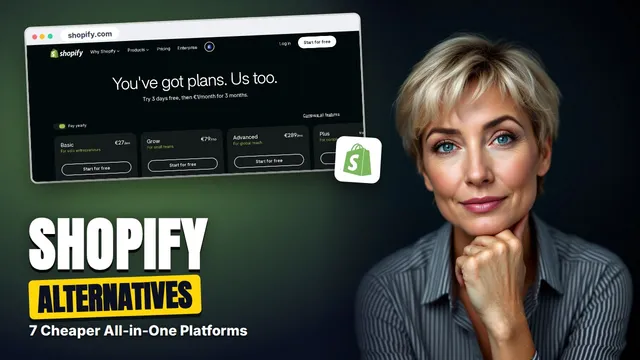
Shopify Review 2026: Independent Test & Real Costs Decoded
Looking for a reliable Shopify review before you commit? Smart move. Shopify is everywhere — in Reddit threads, YouTube tutorials, and Facebook groups — but between sponsored posts and hand-picked testimonials, it’s hard to know what you’re actually signing up for financially.
In this independent review, we look at Shopify from every angle: its real strengths, its concrete limitations, and — most importantly — what you’ll actually be spending each month once the essential apps are in place. Because the advertised $39/month Basic plan is nowhere near the true cost of a fully operational store.
What you’ll find in this article:
- A clear explanation of what Shopify is and how it works
- A breakdown of real Shopify pricing in 2026, apps and fees included
- The objective advantages consistently confirmed by the merchant community
- The drawbacks and limitations that negative reviews flag most often
- An honest comparison with alternatives for tighter budgets
No affiliation with Shopify. No promotional bias. Just the facts.
Table of Contents
- What Is Shopify, Exactly?
- Real Shopify Pricing in 2026: What You’ll Actually Pay
- Shopify’s Confirmed Advantages
- Shopify’s Drawbacks and Limits: Negative Reviews Under the Microscope
- What Sellers Are Really Saying: Review Roundup
- Who Is Shopify Actually Right For in 2026?
- The All-in-One Alternative: Ekomspace, Zero Paid Apps
- Final Verdict: Is Shopify Really Worth the Price in 2026?
- FAQ — Shopify Review
What Is Shopify, Exactly?
A Canadian SaaS Born in 2006: The Concept in Two Minutes
Shopify is an e-commerce platform founded in 2006 in Ottawa, Canada. Its pitch is straightforward: let anyone — regardless of technical skill — build and run a professional online store. It’s what’s known as a hosted SaaS (Software as a Service) — you manage no servers, no software installs, no manual updates. All the infrastructure is hosted and maintained by Shopify.
In practice, what is Shopify for a merchant day-to-day? A centralized dashboard where you manage your products, orders, inventory, payments, and analytics. Your store runs on Shopify’s servers: you’re essentially renting the technology stack that powers your business.
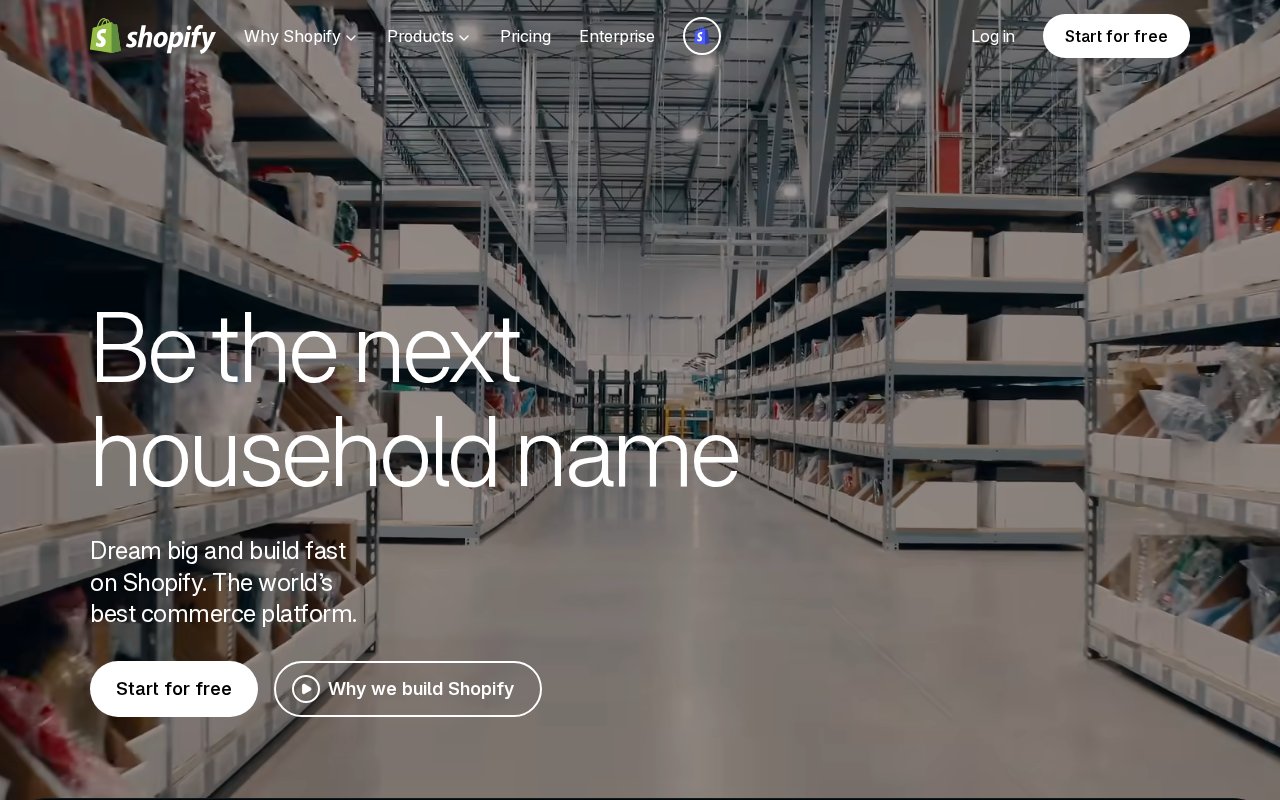 Shopify’s official homepage, positioning itself as the platform for ambitious brands aiming to become the next household name.
How Shopify Actually Works for a Merchant
Shopify’s business model rests on three interconnected pillars:
- The monthly subscription: a fixed plan depending on which tier you choose (Basic, Grow, or Advanced)
- The App Store: a marketplace of third-party applications that extend the platform’s core features
- Shopify Payments: the built-in payment solution that lets you accept cards without an external gateway
These three pillars form a coherent ecosystem — but also a revenue model that generates income for Shopify at multiple levels, which has direct implications for your real budget, as we’ll detail in the next section.
Setting up a Shopify store follows the same basic sequence for virtually every merchant:
- Sign up for Shopify
- Choose a theme
- Add your products
- Install apps
- Activate Shopify Payments
- Store live online
- Sales and analytics
Shopify by the Numbers: Its Place in Global E-Commerce
Shopify is one of the most widely used e-commerce platforms in the world, present in over 170 countries. That global reach is a strong signal: the platform is proven, stable, and backed by a massive developer and merchant community.
This wide adoption directly benefits new sellers — you’ll find resources, tutorials, forums, and service providers in every language. But it comes with a flip side: an ecosystem this large can get expensive fast if you’re not watching how the costs actually stack up.
Real Shopify Pricing in 2026: What You’ll Actually Pay
This is the heart of this review, and the question that almost every Shopify article dances around. The advertised price is not the real price. Here’s why.
The Three Official Plans: Basic, Grow, and Advanced
Shopify offers three main plans in 2026. The official range runs from roughly $29 to $399/month depending on the plan and billing cycle.
| Plan | Monthly subscription (monthly billing) | Transaction fee (without Shopify Payments) | Admin accounts included |
|---|---|---|---|
| Basic | $39/month | 2% | 1 |
| Grow | $105/month | 1% | 5 |
| Advanced | $399/month | 0.6% | 15 |
Annual billing reduces these prices significantly — Basic drops to around $29/month. Many new sellers start month-to-month before committing to an annual plan.
The Basic plan at $39/month is the entry point most often highlighted in Shopify’s marketing. It’s the most accessible starting point — but also the tier with the most limited features and the highest transaction fees (2% without Shopify Payments).
Paid Apps: The Invisible Cost That Piles Up Month After Month
This is where the real Shopify pricing trap lies. The base platform is intentionally stripped-back: many features that any serious e-commerce store genuinely needs are not included natively, and must be added through third-party applications, each billed separately every month.
Features most commonly absent from Shopify’s core:
- Email marketing: to send newsletters and automated sequences
- Upsells and cross-sells: to increase average order value at checkout
- Customer review collection: to display social proof on product pages
- Affiliate program management: to recruit brand ambassadors and affiliates
- Lead capture pop-ups: to build your email list
- Advanced abandoned cart recovery: the native feature on Basic is quite limited
Each of these apps typically runs between $10 and $50/month — sometimes more for full-featured versions or high-volume tiers.
Transaction Fees: When Shopify Takes a Cut of Every Sale
If you don’t use Shopify Payments, Shopify charges a transaction fee on every sale:
- 2% on the Basic plan
- 1% on the Grow (mid-tier) plan
- 0.6% on the Advanced plan
These fees stack on top of your payment processor’s own charges (PayPal, Stripe, etc.). For a merchant moving meaningful volume, that adds up fast. The good news: if you activate Shopify Payments — available in the US, UK, Canada, Australia, and many other markets — these additional transaction fees disappear. That said, Shopify Payments isn’t suitable for every business type or product category.
Premium Themes: Often Necessary, Rarely Free
Shopify offers a handful of free themes — but selection is limited and they’re often not enough to stand out visually in a competitive market. Premium themes, which offer more customization and advanced features, are sold between $150 and $400 as a one-time purchase on the Shopify Theme Store.
Even as a one-time cost, it needs to be factored into your startup budget and amortized over time.
A Hypothetical Example: What Does a Real Monthly Budget Look Like for a Beginner?
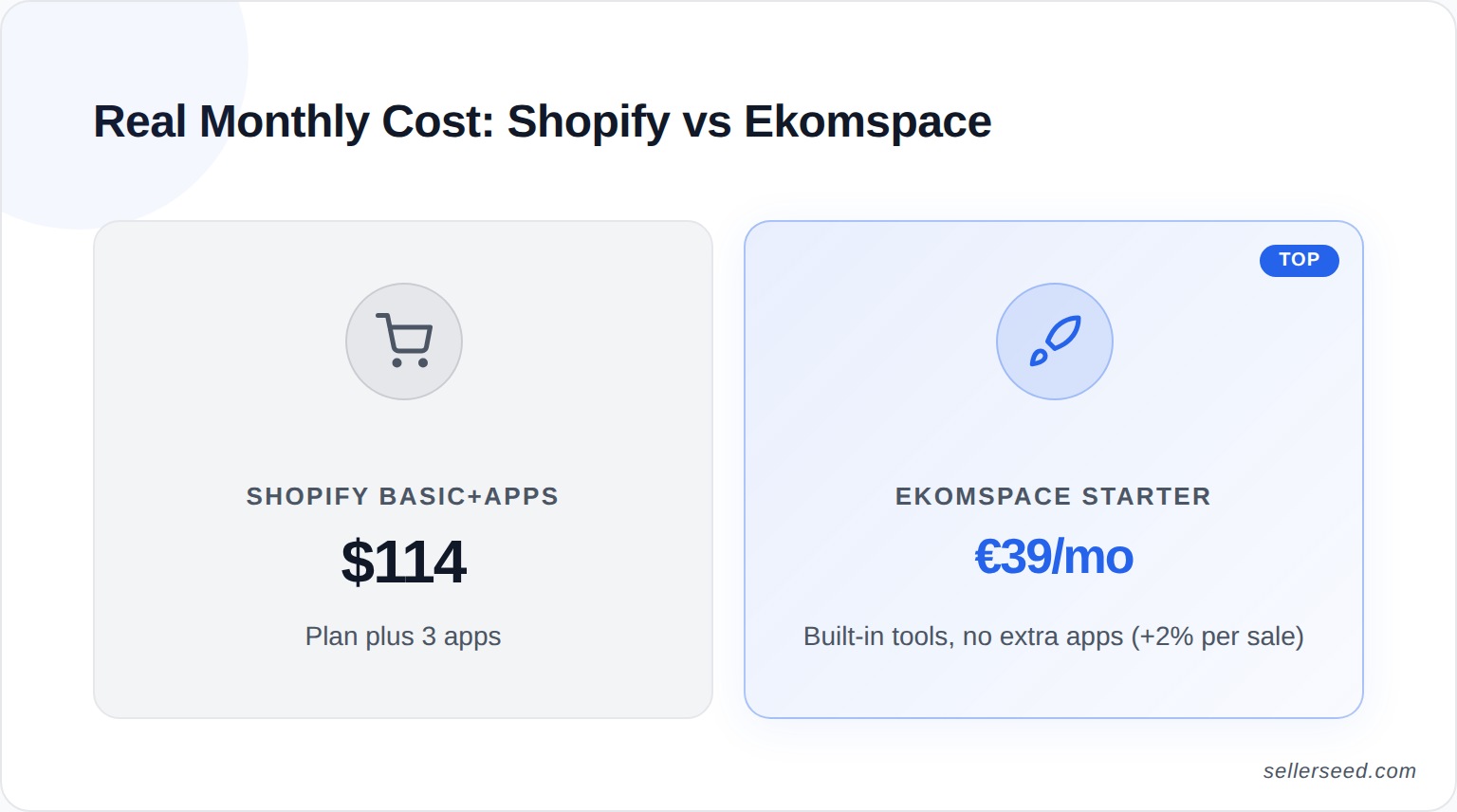
To make this concrete, here’s a purely illustrative scenario: a new merchant on the Basic plan at $39/month who installs three standard apps — email marketing, upsells, and customer reviews — at around $20–25/month each is already looking at a monthly spend well over $100. And that’s before factoring in transaction fees and amortizing the premium theme.
This isn’t a knock on the platform — it’s simply the reality of the Shopify model that forums and Shopify merchant reviews point out again and again.
Shopify’s Confirmed Advantages
Let’s be clear: Shopify is a quality platform. Here’s why so many merchants stay loyal to it.
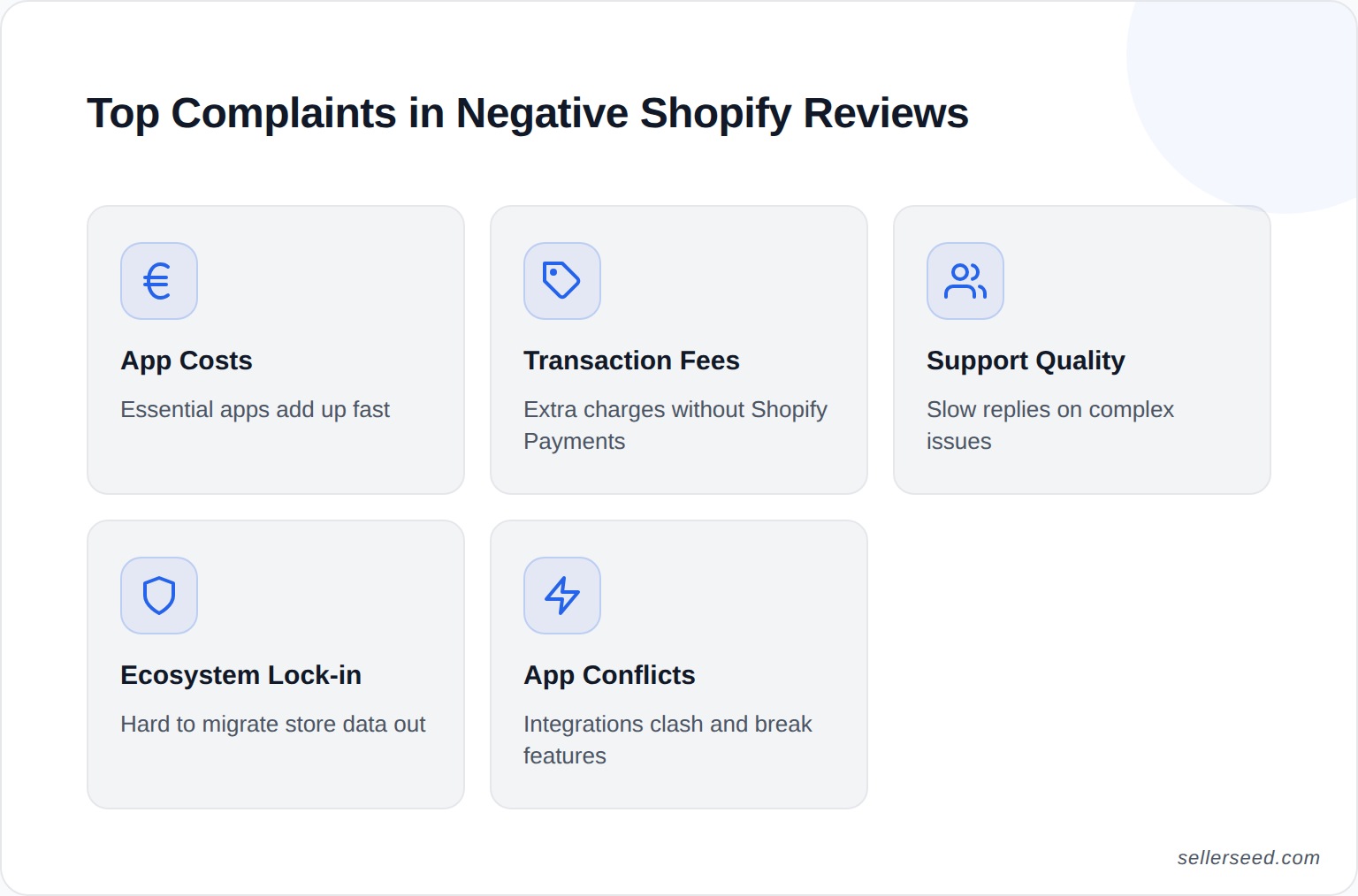
Fast Setup — Even With Zero Technical Skills
This is one of Shopify’s strongest selling points: the interface is built for non-developers. The dashboard is clean, adding a product is intuitive, and it’s genuinely possible to launch a first store in a few hours without writing a single line of code.
This advantage is especially valuable for beginners who don’t want to deal with the technical complexity of a self-hosted solution like PrestaShop or WooCommerce, both of which require managing hosting, updates, and security yourself.
A Massive App Ecosystem and Active Global Community
The Shopify App Store contains thousands of applications covering virtually every business need: logistics, marketing, customer service, accounting, dropshipping, SEO, and more. Whatever your specific challenge, there’s almost certainly a solution in the App Store.
The global Shopify community is also a genuine asset: official forums, dedicated Facebook groups, YouTube channels, multilingual documentation — the support resources are extensive, and you can go from zero to competent quickly.
Technical Reliability: Uptime, SSL, and Scalability Managed by Shopify
With Shopify, you don’t manage infrastructure. The platform continuously handles:
- High uptime, which is critical during traffic spikes (holiday sales, Black Friday)
- An SSL certificate included on every store — essential for security and search engine optimization
- Automatic scalability: your store won’t crash under a sudden rush of visitors
- Backups and updates handled on Shopify’s side, with no action required from you
This is a significant advantage over self-hosted solutions, which require managing all these elements yourself or paying for specialized managed hosting.
Shopify Payments: Accept Cards Without a Third-Party Gateway
Shopify Payments is available in the US, UK, Canada, Australia, New Zealand, Singapore, and other markets. This built-in solution lets you accept card payments without routing through a third-party gateway — and without paying Shopify’s additional transaction fees. The centralized dashboard simplifies managing refunds, disputes, and payouts.
| Shopify strength | What it means in practice |
|---|---|
| Intuitive interface | Store live in hours, no coding required |
| Rich App Store | Thousands of integrations for every business need |
| Managed infrastructure | SSL, uptime, CDN, and backups all included |
| Shopify Payments | Accept cards natively, no extra transaction fees |
| Global community | Deep resources, tutorials, and peer support |
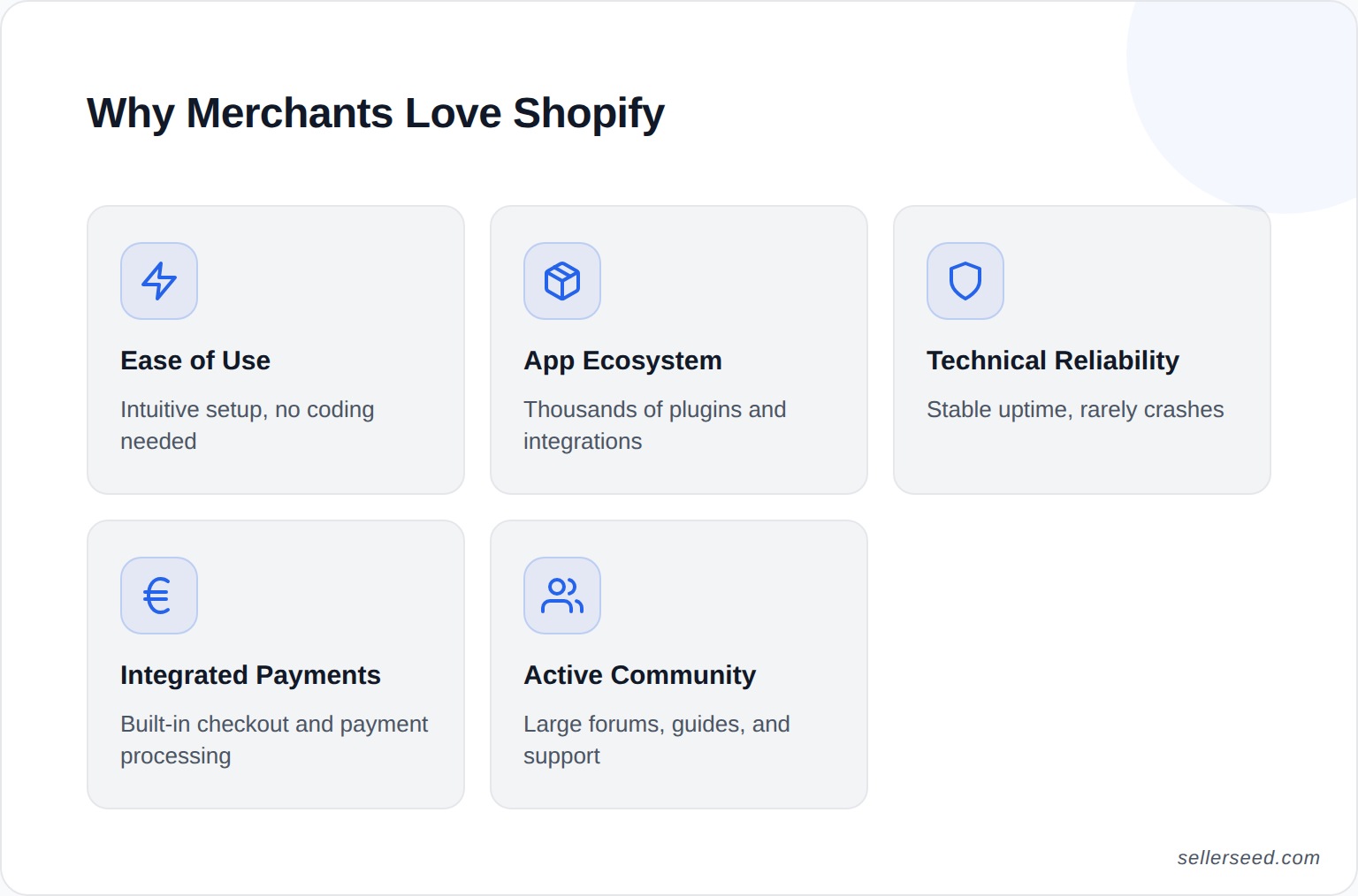
Shopify’s Drawbacks and Limits: Negative Reviews Under the Microscope
Now let’s look at what comes up most consistently in negative Shopify reviews across forums, Trustpilot, and Reddit communities.
The App Trap: Core Features Sold as Add-Ons
This is by far the most common complaint in Shopify forum reviews. Features that form the backbone of any serious e-commerce operation — email marketing, upsells, customer review collection, affiliate management — are not included in the base Shopify subscription.
The direct consequence: your real monthly budget is always higher than the price shown on the pricing page. And the more you grow your store, the more apps (and monthly costs) tend to accumulate.
This pattern is often described in forums as a “Lego effect”: you snap on one app at a time, each with its own monthly subscription. The result can quickly surprise a beginner who budgeted $39/month and ends up spending more than twice that.
Transaction Fees: A Direct Drag on Profitability
The 0.6% to 2% fees that Shopify charges on each sale (without Shopify Payments) can represent a significant cost as your sales volume grows. For merchants selling low-margin products — particularly common in dropshipping — every percentage point directly impacts your bottom line.
Even with Shopify Payments activated, payment processing fees still apply — they’re just structured differently and are typically more competitive than the combination of a subscription plus third-party transaction fees.
Customer Support: Available but With Notable Limitations
Shopify offers 24/7 customer support, but community feedback on its quality is mixed. Priority support with faster response times is generally reserved for higher-tier plans. Merchants on entry-level plans frequently mention inconsistent response times and uneven quality depending on who they reach — a point that surfaces regularly in Shopify reviews shared on specialist forums and communities.
Lock-In to the Shopify Ecosystem: A Long-Term Risk
Choosing Shopify means building your business inside a proprietary ecosystem. Your data, your store, your configurations — everything rests on infrastructure you don’t control. If Shopify changes its pricing, its terms of service, or its App Store rules, you absorb those changes with no negotiating leverage.
This ecosystem lock-in is a risk that intermediate and advanced merchants raise more often than beginners — who tend not to think about it at the start, but sometimes wish they had.
What Comes Up Most in Negative Reviews
Synthesizing feedback from forums and public review platforms, the most frequently cited pain points are:
- Total real cost consistently exceeds initial expectations
- Apps fall out of sync with each other, creating bugs that are hard to diagnose without a developer
- Customer support quality is seen as inconsistent, particularly on entry-tier plans
- Theme updates can break existing CSS customizations
- Transaction fees eat into margins on low-ticket products
For a broader look at the available alternatives, see our comparison of e-commerce platforms.
Build your store with Ekomspace
The all-in-one e-commerce platform with built-in AI — store, emails, upsells, no extra apps to pay for.
Try Ekomspace →What Sellers Are Really Saying: Review Roundup
The Positives That Come Up Most in Merchant Reviews
Analyzing Shopify seller reviews shared across public platforms, several themes recur consistently among satisfied merchants:
- The speed of getting a first store live, often cited as faster than competing platforms
- The quality of the built-in analytics tools (Shopify Analytics), rated as accessible and actionable
- Platform stability during seasonal traffic peaks
- The ease of managing orders day-to-day via the mobile app
- Integrations with marketplaces and social platforms (Meta, TikTok Shop, Amazon)
These positives align closely with Shopify’s positioning: a turnkey solution for launching quickly and running your business without technical friction.
The Most Common Frustrations Expressed in the Community
On the less enthusiastic side, the community most often expresses:
- A monthly bill that climbs fast once you add the essential apps
- Limited flexibility for advanced customization without code or a developer
- Difficulty getting fast, relevant support on entry-tier plans
- A feeling of limited control over data, infrastructure, and platform decisions
These complaints are worth contextualizing: they tend to come from merchants with tight budgets or specific expectations. For a merchant with meaningful sales volume, the app cost becomes proportionally more manageable.
Shopify for Dropshipping: A Use Case Unto Itself
Shopify is frequently associated with dropshipping, and for good reason. The platform integrates with suppliers through dedicated apps, and its interface simplifies automatic order forwarding. For the same need, Ekomspace natively includes AliExpress connectivity, product importing, and semi-automated orders — no separate dropshipping app required. To build your catalog, our guide on finding trending products to sell online can serve as a good starting point.
That said, the question raised regularly in forums — “Is dropshipping actually profitable?” — deserves an honest answer: dropshipping margins are often thin. In that context, Shopify’s transaction fees (2% on Basic without Shopify Payments) and the monthly app bill can meaningfully compress profitability, especially in the launch phase. Any dropshipper needs to build these costs into their projections from day one. Working on your e-commerce conversion rate becomes doubly strategic when margins are already squeezed.
| Seller profile | Overall Shopify satisfaction | Main pain point |
|---|---|---|
| Beginner (< $1,000/month revenue) | Mixed | Total real cost with apps |
| Intermediate ($1,000–$10,000/month) | Generally positive | Fees and support |
| Advanced (> $10,000/month) | Positive | Ecosystem lock-in |
| Dropshipping (all sizes) | Variable | Fees + thin margins |
Who Is Shopify Actually Right For in 2026?
The Ideal Shopify Profile: When the Platform Delivers
Shopify is particularly well-suited to merchants who meet these criteria:
- You have a monthly budget of at least $100–$150 to put toward your e-commerce infrastructure (subscription + essential apps)
- You expect enough sales volume to absorb the transaction fees
- You value ease of use and don’t want to deal with the technical side
- You need to integrate with many third-party tools (ERP, logistics, marketplaces)
- You have a high-growth potential business or already have established volume
Profiles Where Shopify’s Cost Structure May Not Work
Conversely, some profiles will be less well served:
- Beginners on a tight budget who will quickly hit the ceiling once apps are added
- Merchants who need many native marketing features without stacking subscriptions
- Those selling low-margin products where transaction fees hit profitability directly
- Merchants who want an all-in-one platform with no dependency on an external App Store
Three Questions to Ask Before Committing
Question 1: What’s my realistic monthly budget, apps included? If your honest answer is “under $100/month,” explore alternatives before locking into Shopify.
Question 2: Do I need email marketing, upsells, or customer review tools? If yes, price out the apps before you sign up. These features are absent natively on Shopify Basic.
Question 3: What monthly sales volume am I projecting in the first six months? If your volume is low, transaction fees stay manageable. If you scale fast, plan for an upgrade to a higher tier — or activate Shopify Payments early.
Based on your budget and situation, here’s which option tends to make the most sense:
| Your situation | Best choice | Why |
|---|---|---|
| Monthly budget under $100 | An all-in-one solution (e.g. Ekomspace) | Shopify’s stacked app subscriptions will quickly exceed this budget |
| Budget over $150/month, high and growing sales volume | Shopify | Your volume comfortably absorbs transaction fees and app costs |
| Budget over $150/month, low volume for now, several essential marketing apps needed | An all-in-one solution (e.g. Ekomspace) | Stacking paid apps on a still-small budget erodes Shopify’s cost advantage |
| Budget over $150/month, low volume for now, few or no essential marketing apps needed | Shopify | The core platform already covers your needs without extra app costs |
The All-in-One Alternative: Ekomspace, Zero Paid Apps
If you’ve read this far and the Shopify model — subscription + apps + fees — doesn’t match your profile or budget, there are serious alternatives. Among them, Ekomspace stands out for a fundamentally different approach.
Ekomspace vs. Shopify: What Actually Changes for Your Budget
The first difference shows up immediately on the pricing line: Ekomspace Starter from €29/month on a 24-month commitment, compared to Shopify Basic at $39/month. But what’s included is what changes everything.
Where Shopify charges you separately for essential marketing features, Ekomspace natively includes in its subscription:
- Email marketing — a built-in proprietary tool, no third-party app
- Upsells — average order value boosters built directly into the checkout flow
- Affiliate management — recruit brand ambassadors with no extra subscription
- Customer review collection — social proof without an add-on
In concrete terms, the features you’d pay $30–$100/month for in Shopify apps are already part of your Ekomspace subscription.
Native Features Included at No Extra Cost in Ekomspace
Here’s a direct feature comparison between the two platforms:
| Feature | Shopify Basic ($39/month) | Ekomspace Starter (€29/month¹) |
|---|---|---|
| Email marketing | Paid third-party app | Included natively |
| Upsells / cross-sells | Paid third-party app | Included natively |
| Affiliate program | Paid third-party app | Included natively |
| Customer review collection | Paid third-party app | Included natively |
| AI-powered page builder | Not available | Included natively |
| Transaction fees | 2% (without Shopify Payments) | 0.5% to 2% depending on plan (on all sales) |
¹ on 24-month commitment — monthly Starter plan available at €39/month
The Built-in AI Page Builder: A Radically Different Approach to Themes
This may be the most fundamental difference between the two platforms. Where Shopify offers a theme catalog (free or paid, $150–$400) that you customize manually, Ekomspace integrates an AI-powered page builder: there’s no rigid theme library, because the AI modifies the design and layout directly based on your instructions.
This approach eliminates the premium theme cost entirely and significantly simplifies customization for merchants without design or web development skills. You describe what you want — the AI applies it.
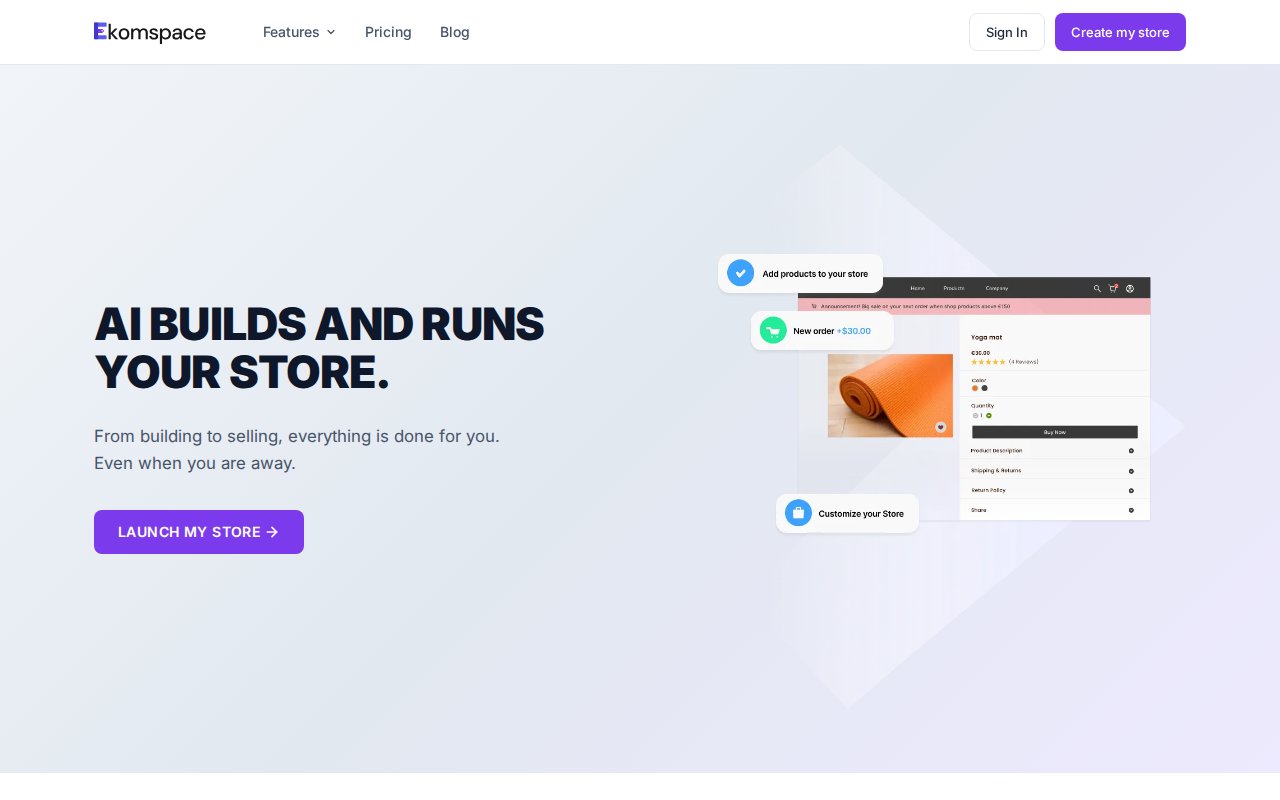 Ekomspace’s official homepage, built around its core promise: AI builds and runs your store.
Ekomspace Pricing: What You Actually Pay, No Surprises
| Ekomspace Plan | Monthly rate (24-month commitment) | Monthly rate (no commitment) |
|---|---|---|
| Starter | €29/month | €39/month |
| Pro | — | €99/month |
| Business | — | €299/month |
For a point-by-point platform comparison, see our Shopify vs. Ekomspace breakdown. For an independent look at the platform on its own, see our Ekomspace review.
Final Verdict: Is Shopify Really Worth the Price in 2026?
Objective Summary: Shopify’s Strengths and Weaknesses at a Glance
Shopify is a mature, reliable, technically solid platform. For merchants with meaningful sales volume and a monthly budget large enough to absorb the app costs, it’s a credible option with a proven track record at global scale.
But for beginners and merchants on tighter budgets, the real total cost consistently exceeds initial expectations — and that’s precisely what forum reviews flag most often.
Our Overall Rating and Recommendation by Profile
As an editorial judgment, based on analysis of public reviews and the platform’s pricing structure:
- Features and infrastructure: 4/5 — interface and technical reliability are top-tier
- Cost-to-value for beginners: 2.5/5 — total real cost can come as a genuine shock
- Cost-to-value for established merchants: 3.5/5 — apps become proportionally lighter as volume grows
- Ease of use: 5/5 — among the best in the market on this metric
Which Platform Should You Choose Based on Your Situation?
- You have a comfortable monthly budget and an ambitious project → Shopify is a solid, proven option
- You’re just starting out, budget is tight, and you need email marketing, upsells, and affiliate tools from day one → an all-in-one platform like Ekomspace will be more cost-effective and more predictable
- You want to compare all options before deciding → weigh up Shopify vs. Ekomspace feature by feature before you commit
Conclusion
Shopify is far from a bad platform — it’s one of the most complete and reliable e-commerce solutions on the market. But its forum reviews reveal a reality that sponsored articles gloss over too often: the real total cost of a fully operational Shopify store consistently exceeds the number on the pricing page once you add essential apps, transaction fees, and a premium theme.
If you have the sales volume and budget to absorb those costs, Shopify delivers on its promises. If you’re starting out with a limited budget, or you need native marketing features without stacking subscriptions, it’s worth exploring alternatives before you commit.
For e-commerce merchants looking for an all-in-one solution with transparent pricing and no paid add-ons, we invite you to try the platform that includes store, emails, upsells, and affiliate management in its base subscription.
FAQ — Shopify Review
Is Shopify really free to start selling online? No. Shopify offers a free trial for a few days, but there is no permanent free plan. The Basic plan starts at $39/month on monthly billing, or $29/month on an annual plan — to which you need to add the cost of apps, a premium theme, and transaction fees. The real cost of a working store is always higher than the subscription price alone.
What are the hidden costs of Shopify that you don’t see upfront? The main hidden costs are paid third-party apps for email marketing, upsells, customer reviews, and affiliate programs — features not natively included in Shopify Basic. Add premium themes ($150–$400 as a one-time purchase) and transaction fees of 0.6% to 2% if you don’t use Shopify Payments.
Why does Shopify charge me transaction fees on my sales? Shopify charges transaction fees when you use a third-party payment processor rather than Shopify Payments. These fees are 2% on Basic, 1% on the mid-tier Grow plan, and 0.6% on Advanced. They’re eliminated if you activate Shopify Payments, available in the US, UK, Canada, Australia, New Zealand, Singapore, and other markets.
Is Shopify suitable for beginners with no technical background? Yes — Shopify is one of the most accessible platforms for beginners. The interface is intuitive and you can build a store without writing any code. The main caveat is budget: make sure you include the cost of essential apps in your monthly projection, or you’ll be surprised after the first few weeks.
What is the best Shopify alternative for a small budget? Ekomspace is an all-in-one alternative that natively includes email marketing, upsells, affiliate programs, and review collection with no paid third-party apps. The Starter plan begins at €29/month on a 24-month commitment, with a built-in AI page builder that eliminates the need for a premium theme.
Is Shopify profitable for dropshipping in 2026? Shopify is a common choice for dropshipping, with many integrations available through the App Store. An all-in-one platform like Ekomspace addresses the same need with native AliExpress connectivity and semi-automated orders — no additional dropshipping app required. That said, dropshipping margins are often thin, and Shopify’s transaction fees (2% on Basic without Shopify Payments) plus app costs need to be built into your profitability projections from day one to avoid unpleasant surprises.
Related Articles
- Best e-commerce platforms compared in 2026
- Shopify vs. Ekomspace: which platform should you choose for your store?
- Our independent, full Ekomspace review
- Can you build a Shopify store for free — myth or reality?
- How to launch your e-commerce business in 2026: the complete beginner’s guide
Build your own store with Ekomspace
The all-in-one e-commerce platform with built-in AI — store, emails, upsells, all without extra apps.
Try Ekomspace →