Shopify Alternatives: 7 Cheaper All-in-One Platforms
By Marc Fontaine · Updated November 19, 2026 · 15 min read
Shopify is the undisputed market leader in SaaS e-commerce. Founded in 2006 and headquartered in Ottawa, Canada, it powers over 5 million active stores across more than 175 countries. The platform set the standard for online selling, and its reputation is well earned. For a thorough look at exactly what you get — and where the cracks appear — our Shopify Review 2026: Honest Verdict, Pricing & Limits covers every plan, fee, and limitation in detail.
But in 2026, there are real Shopify alternatives — and for many merchants, those alternatives are significantly cheaper when you count the full bill.
The problem with Shopify isn’t the sticker price. It’s what happens after you sign up. Add email marketing, post-purchase upsells, customer reviews, an SEO app, and a premium theme — the standard toolkit for a competitive store — and your monthly spend can easily double or triple before you’ve made a single sale. Add in the per-transaction fees if you’re in a country where Shopify Payments isn’t available, and the gap widens further.
This guide cuts through the noise. We’ve compared seven of the best Shopify alternatives on real total cost, feature coverage, ease of use, and who each platform is actually built for. Every review follows the same structure so you can compare apples to apples and find the right fit without reading the whole article.
Table of Contents
- Why Shopify merchants look for alternatives
- Quick comparison: all 7 platforms at a glance
- The 7 best Shopify alternatives
- How to choose the right platform
- FAQ
Why Shopify Merchants Look for Alternatives
The real cost of Shopify goes way beyond the sticker price
Shopify’s pricing page is clean and confident. Four plans — Basic, Grow, Advanced, Plus — with a headline price and a 3-day free trial.
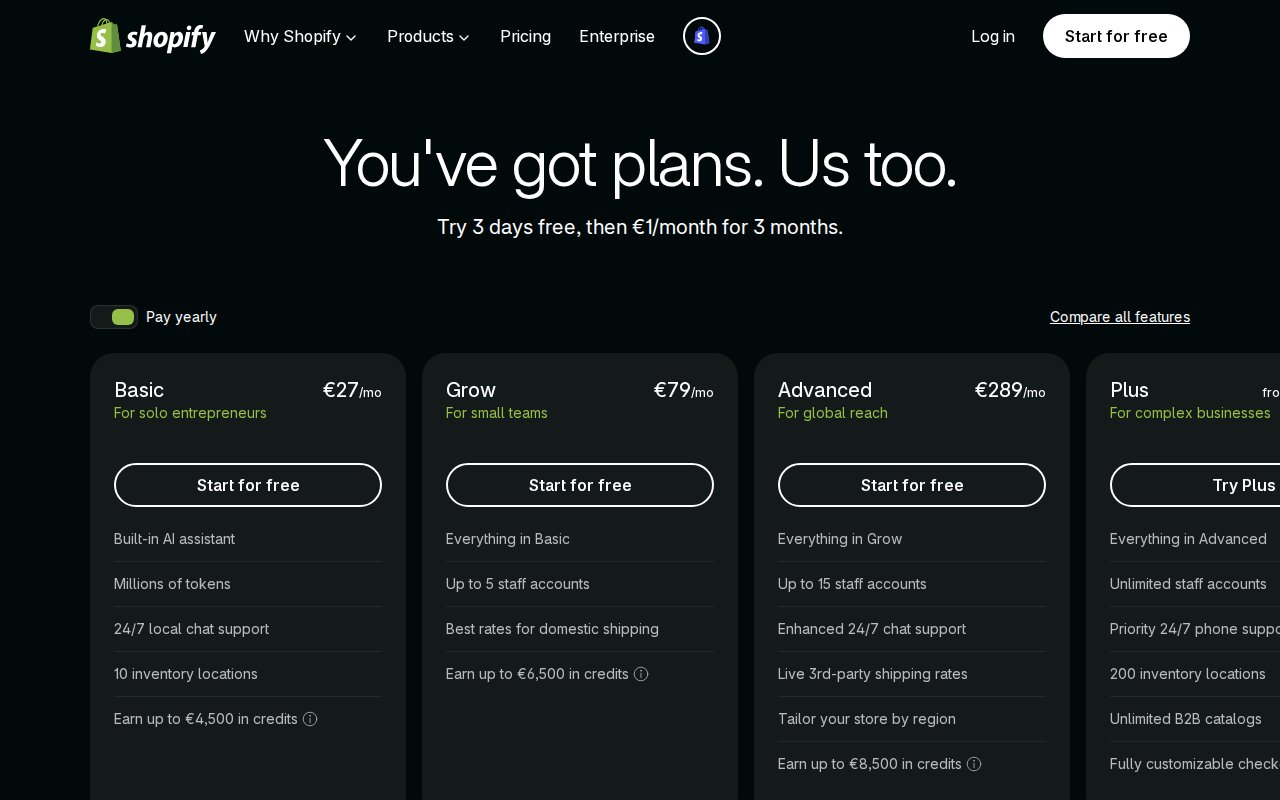 Shopify’s official pricing page as of 2026, showing all four plans.
Here’s what those plans cost in the US:
| Plan | Monthly billing | Annual billing |
|---|---|---|
| Basic | $39/mo | $29/mo |
| Grow | $105/mo | $79/mo |
| Advanced | $399/mo | $299/mo |
| Plus | From $2,300/mo | — |
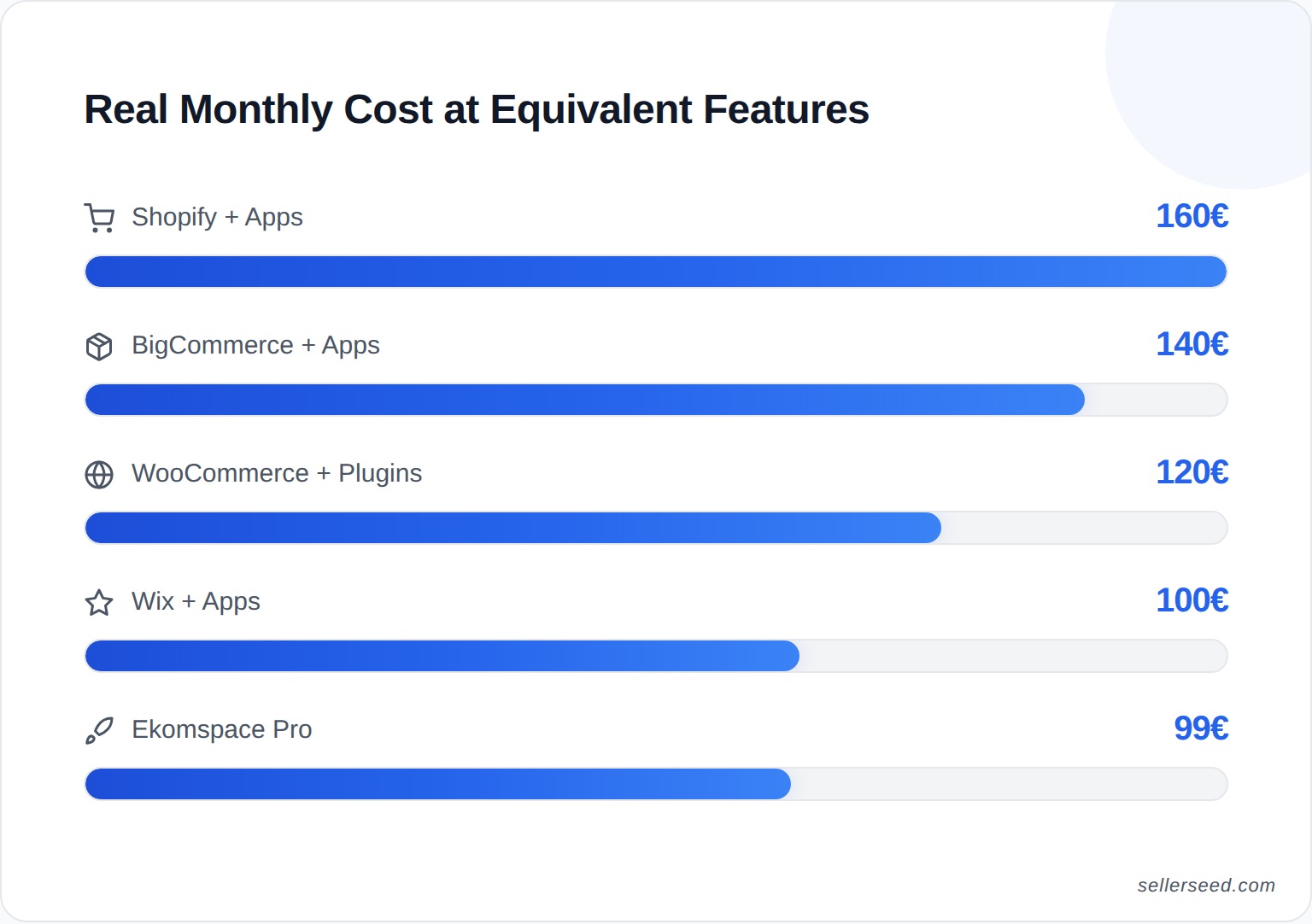
Reasonable, on the surface. But Shopify’s business model relies heavily on its app marketplace — which means the features most stores actually need aren’t included in the base plan. Here’s what a typical Shopify Basic store ends up paying:
| Cost item | Shopify Basic | Ekomspace Pro |
|---|---|---|
| Platform subscription | $39/mo | €99/mo |
| Email marketing (Klaviyo / Shopify Email) | $20–$50/mo | Included |
| Post-purchase upsells (ReConvert, Bold) | $10–$30/mo | Included |
| SEO app (Plug In SEO, Smart SEO) | $10–$20/mo | Included |
| Customer reviews (Judge.me, Loox) | $0–$15/mo | Included |
| Pop-ups / lead capture (Privy, OptiMonk) | $0–$30/mo | Included |
| Premium theme | $150–$400 one-time | N/A (AI builder) |
| Estimated monthly all-in | $70–$150/mo+ | €99/mo (all-in) |
Currencies differ: Shopify prices in USD, Ekomspace in EUR. Check the current rate to compare directly. The key point is not the absolute figures — it’s that Ekomspace’s price is a known ceiling, while Shopify’s is a floor.
Transaction fees hit harder outside Shopify Payments countries
If you use any payment processor other than Shopify Payments, Shopify charges an additional transaction fee on every sale: 2% on Basic, 1% on Grow, 0.6% on Advanced, 0.2% on Plus. Those fees stack on top of whatever Stripe, PayPal, or your local gateway charges.
Shopify Payments eliminates this fee — but it’s only available in around 40 countries, including the US, UK, Canada, Australia, New Zealand, and Singapore. If you’re based in India, Nigeria, Kenya, the Philippines, South Africa, or most of the Caribbean, you’re paying that transaction fee on every order.
For comparison: Ekomspace also charges a sales commission (2% on Starter, 1% on Pro, 0.5% on Business), which stacks on top of your payment processor fees. It’s worth comparing both honestly before choosing.
The app stack creates complexity and unpredictability
Over 20,000 apps in the Shopify App Store is an impressive number. It’s also a symptom of the problem: when five separate subscriptions are required to run a standard marketing setup, the “power” of a large marketplace starts to look like a hidden tax on your monthly expenses. Five dashboards, five billing cycles, five support contacts.
URL rigidity limits SEO flexibility
Shopify locks your product URLs under /products/ and your collection pages under /collections/. You cannot change this. For merchants with a deliberate SEO strategy, that’s a real constraint — full URL control is a standard feature on most platforms reviewed here.
Quick Comparison: All 7 Shopify Alternatives at a Glance
| Platform | Starting price | Transaction fee | Email marketing | Upsells | Type | Best for |
|---|---|---|---|---|---|---|
| Ekomspace | €39/mo | 2 % (Starter) | ✅ Included | ✅ Included | SaaS | All-in-one, beginners |
| BigCommerce | $39/mo | 0 % | ❌ App needed | ❌ App needed | SaaS | High volume, no extra fees |
| WooCommerce | Hosting + plugins, from ~$10/mo | 0 % | ❌ Plugin needed | ❌ Plugin needed | Self-hosted | Developers, WordPress users |
| Wix | ~$29/mo | 0 % | ✅ Basic | ❌ App needed | SaaS | Small stores, visual design |
| Squarespace | ~$19/mo | 0 % (Core plan+) | ✅ Basic | ❌ App needed | SaaS | Design-first brands |
| PrestaShop | Hosting + modules, from ~$10/mo | 0 % | ❌ Module needed | ❌ Module needed | Self-hosted | Tech-savvy, full control |
| Ecwid by Lightspeed | From $5/mo | 0 % | ❌ App needed | ❌ App needed | SaaS | Adding a cart to an existing site |
Entry-level paid plan prices on annual billing where available. Ekomspace prices in EUR; all others in USD unless noted. Verify current pricing on each platform’s official site.
The 7 Best Shopify Alternatives in 2026
1. Ekomspace — Best All-in-One Value
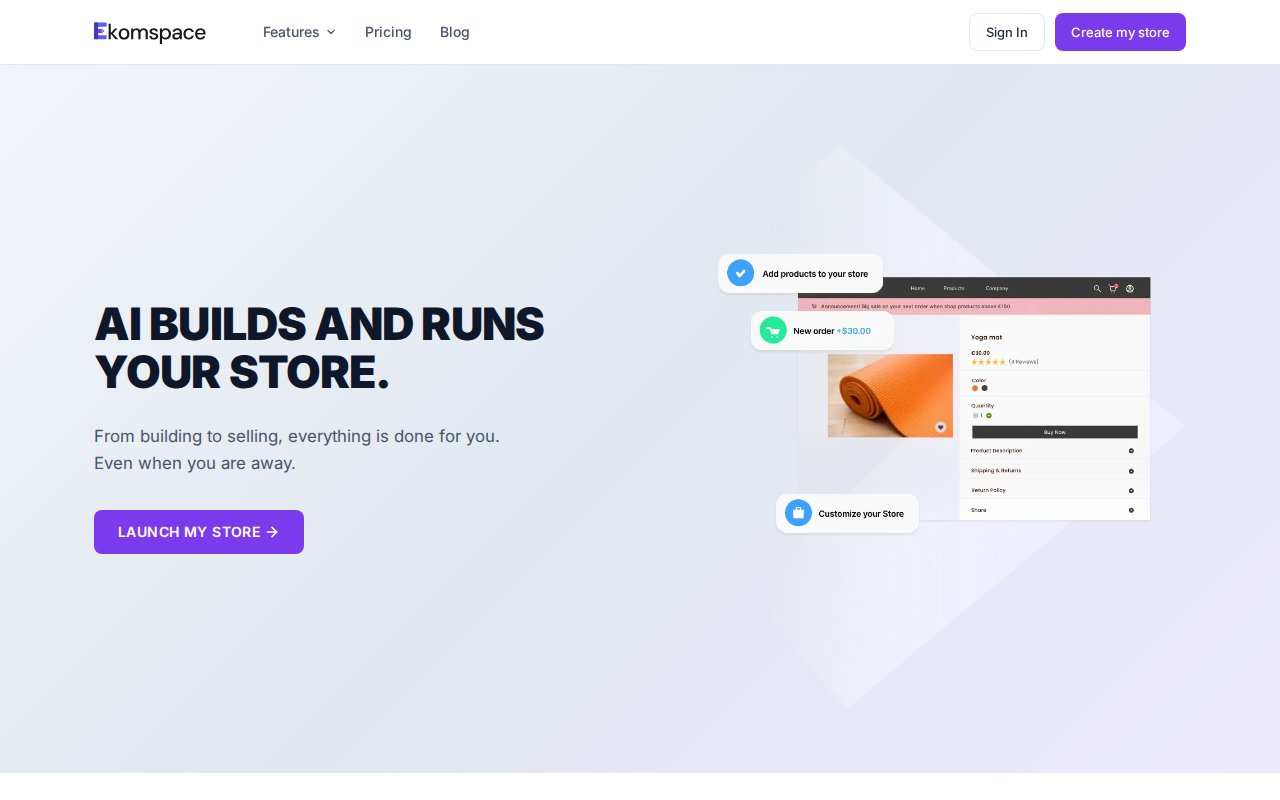 Ekomspace’s official homepage, showcasing the AI-powered store builder and dashboard.
Best for: Entrepreneurs who want a fully equipped, ready-to-sell store without assembling a stack of apps.
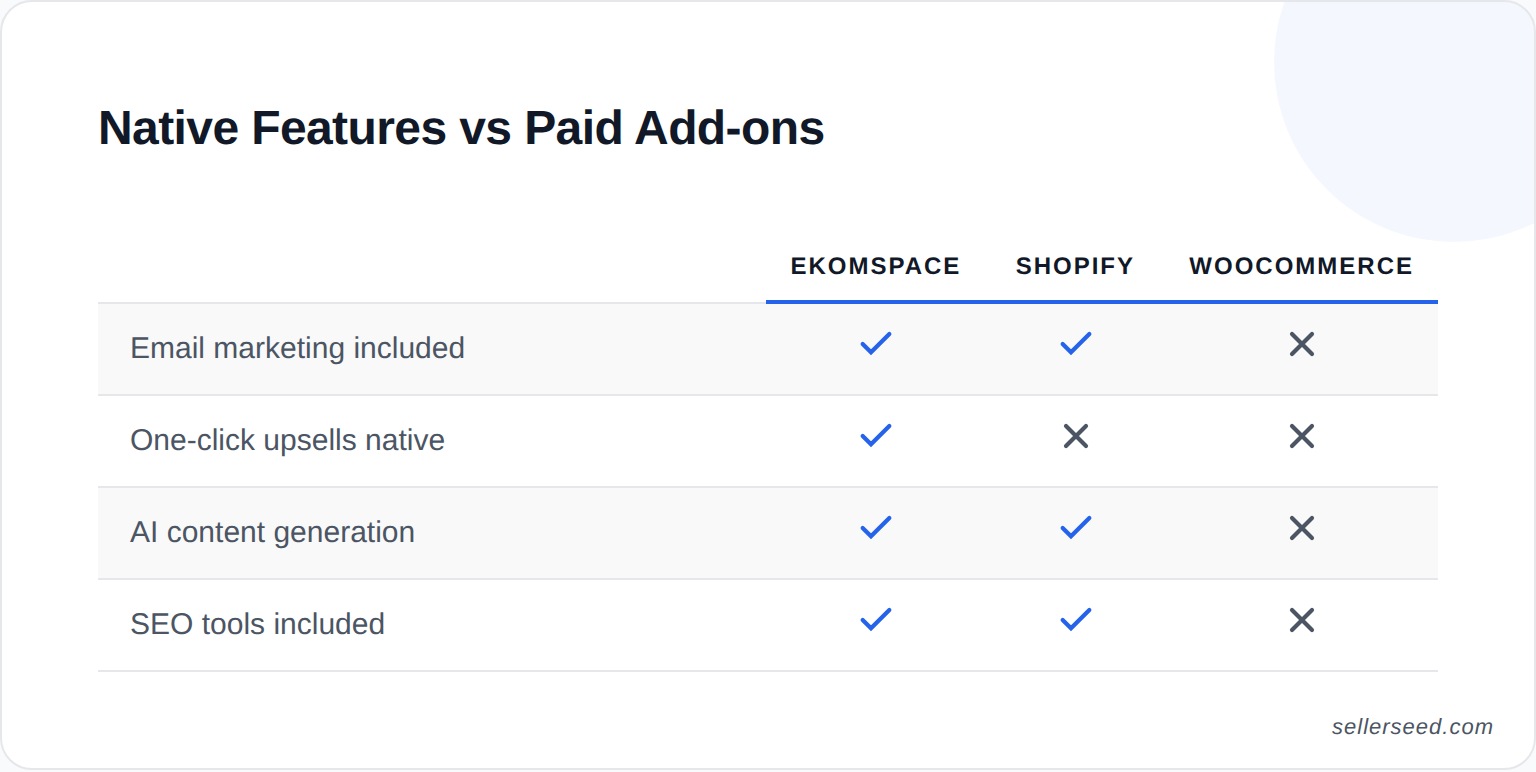
Ekomspace is a SaaS e-commerce platform built by Olyria Technology LLC, a Delaware-registered company. Where Shopify’s model is “buy the platform, then buy the features,” Ekomspace ships with email marketing, upsells, order bumps, an AI blog agent, an AI customer service agent, affiliate management, customer reviews, and a customizable checkout built in from day one.
The philosophy is straightforward: pay one predictable price, get everything. No app hunting, no juggling multiple dashboards, no month-end surprise on your credit card.
Pricing
| Plan | Monthly | 12-month billing | 24-month billing |
|---|---|---|---|
| Starter | €39/mo | €32/mo (€384/yr) | €29/mo (€696 / 2 yrs) |
| Pro (recommended) | €99/mo | €82/mo (€984/yr) | €75/mo (€1,800 / 2 yrs) |
| Business | €299/mo | €249/mo (€2,988/yr) | €225/mo (€5,400 / 2 yrs) |
Prices in EUR. The monthly plan has no lock-in — cancel any time. There is no free trial; plans are billed by card. Ekomspace also charges a sales commission (2% Starter · 1% Pro · 0.5% Business) on top of your payment processor’s fees (Stripe, PayPal, Apple Pay, Google Pay, Klarna). One store per account.
Key Features
Store building & AI
- Full page builder, plus an AI that generates your entire store from your inputs and can modify it via chat
- AI generates product descriptions, email copy, images, and page sections
- AI blog agent: publishes SEO-optimized articles daily on a schedule you define, following a full content strategy
- AI customer service agent: answers buyer questions and “where’s my order?” queries via a chat bubble, with handoff to a human in the mobile app
- Back-office interface available in 40 languages
E-commerce
- Products, variants, collections, and stock management
- AliExpress integration with semi-automatic order forwarding (you confirm payment — not fully automatic)
- Multi-currency support across all storefronts
- One-page, fully customizable checkout
- Cash on delivery (COD) supported
- One language per store (create a separate store per language)
- Connecting an existing domain is easy; domain purchase from within Ekomspace is coming soon
Marketing (all built in)
- Email campaigns, transactional emails, and automation flows (abandoned cart, site visit, welcome series)
- One-click post-purchase upsells and order bumps
- Bundles, volume discounts, and cart drawer
- Pop-ups and email capture with automation sequences
- Full affiliate management system
- Customer review collection and display
Plan limits
- Starter: 3 users · 2,000 contacts · 500 products · 20 AI credits/mo
- Pro: 5 users · 10,000 contacts · unlimited products · 50 AI credits/mo
- Business: unlimited users · unlimited contacts · unlimited products · 150 AI credits/mo
Pros
- Everything in one subscription — email, upsells, reviews, affiliate, AI
- Predictable monthly bill with no hidden app costs
- Full URL freedom for SEO (no forced /products/ prefix)
- AI page builder removes the need for a premium theme
- Native SEO tools: meta tags, sitemap, schema markup, image optimization
- RTL support for Arabic and Hebrew storefronts
- 24/7 support
Cons
- No free trial (though the monthly plan is no-commitment)
- Sales commission stacks on top of payment processor fees — factor this into your margin calculations
- No app marketplace: if you need a niche integration not built in, there’s no workaround
- One store per account; multi-language setups need multiple subscriptions
- Domain purchase not yet available directly from Ekomspace
Verdict
Ekomspace is the strongest all-in-one Shopify alternative on this list for merchants who want a complete stack without paying app by app. The pricing becomes very competitive once you count what you won’t need to buy separately. It’s the clearest fit for first-time store owners and lean teams who want to focus on selling, not on software management.
Build your store with Ekomspace
The all-in-one e-commerce platform with built-in AI — store, emails, upsells, no extra apps to pay for.
Try Ekomspace →2. BigCommerce — Best for Scaling Without Transaction Fees
Best for: Growing and established merchants who need enterprise-level features without Shopify’s per-sale fees.
BigCommerce is a US-based, Nasdaq-listed SaaS platform that competes directly with Shopify at the mid-market and enterprise level. Its most significant structural advantage: zero transaction fees on every plan when you use one of its supported payment gateways. For high-revenue stores, that difference compounds fast.
Pricing
| Plan | Monthly billing |
|---|---|
| Core | $39/mo |
| Growth | $105/mo |
| Scale | $399/mo |
| Performance | From $1,499/mo |
Annual billing reduces prices. Note that BigCommerce ties each plan to an annual GMV (gross merchandise volume) threshold — if your store exceeds the limit, you’re automatically moved up.
Key Features
- Zero transaction fees across all plans
- Unlimited staff accounts on all tiers
- Native multi-currency and multi-language
- Strong built-in SEO with full URL control (no forced prefixes)
- Multi-channel selling: Amazon, eBay, Facebook, Instagram, TikTok, Google Shopping
- B2B features: customer groups, negotiated pricing, quote management
- Headless commerce support for custom frontends
Pros
- No transaction fees, ever
- Generous native feature set at every tier
- Excellent SEO out of the box
- Strong scalability for high-volume stores
- Good international selling tools
Cons
- Revenue caps per plan mean forced upgrades as you grow
- Email marketing and upsells still require third-party apps
- Smaller app marketplace than Shopify (~1,000+ apps)
- Steeper learning curve than Shopify, Wix, or Ekomspace
- Premium themes cost extra
Verdict
BigCommerce is the right answer for merchants who’ve outgrown Shopify Basic and are tired of either paying transaction fees or upgrading to Grow/Advanced just to reduce them. It’s less beginner-friendly, but very powerful for stores that already know what they’re doing.
To put BigCommerce’s zero-fee advantage in sharper relief, it helps to know exactly what Shopify charges at each plan tier and when those fees kick in. Our Shopify Review 2026: Honest Verdict, Pricing & Limits breaks down every plan’s transaction fee structure, GMV thresholds, and the conditions under which Shopify Payments is available, giving you the precise numbers to run a side-by-side cost comparison against your projected revenue.
3. WooCommerce — Best Open-Source Option
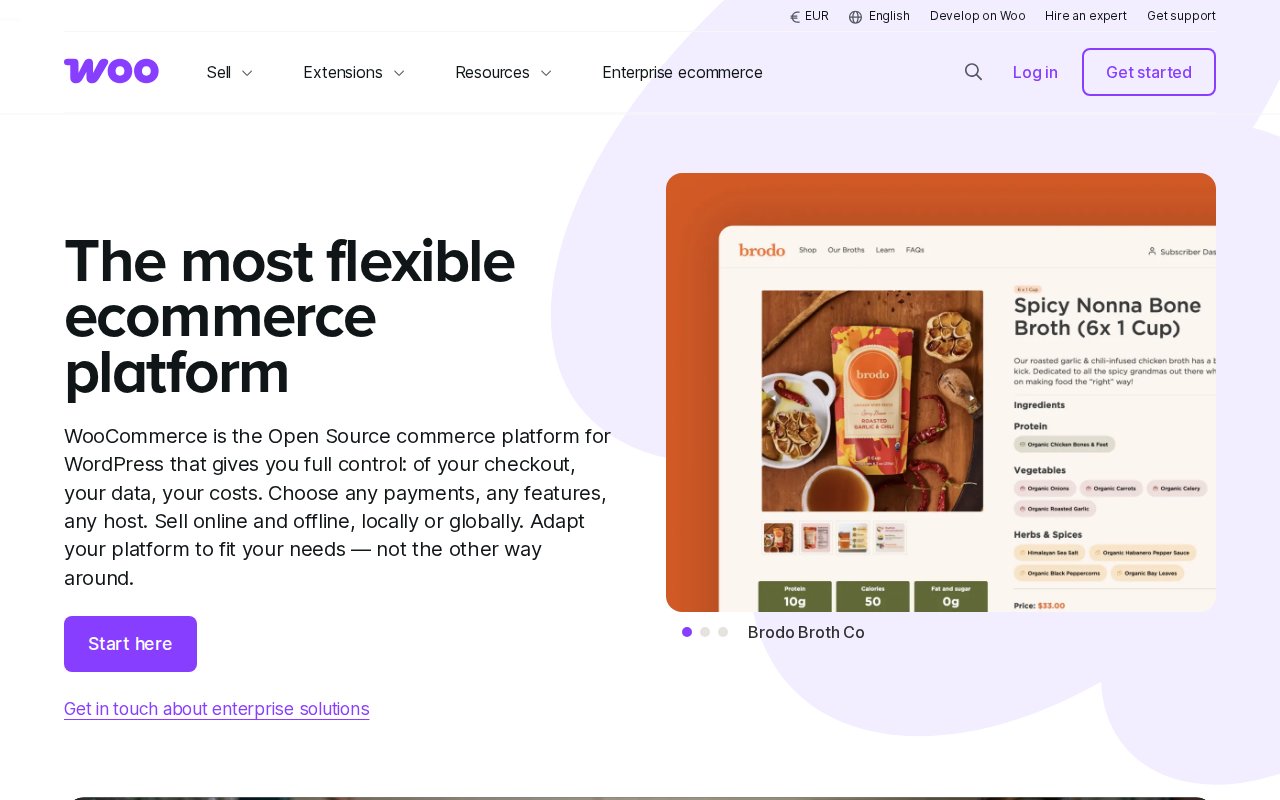 WooCommerce’s official homepage, featuring real stores powered by the platform.
Best for: WordPress users, developers, and anyone who needs maximum ownership, flexibility, and control.
WooCommerce is an open-source e-commerce plugin for WordPress with no software licence fee. It powers roughly a third of all online stores worldwide — by far the largest share of any single platform. That reach comes with a massive ecosystem: thousands of free and paid plugins, an enormous developer community, and deep documentation covering almost every conceivable use case.
Pricing
The plugin itself carries no licence fee. What you’ll actually spend:
| Cost item | Approximate range |
|---|---|
| WordPress hosting | $5–$30/mo (Bluehost, SiteGround, WP Engine, Kinsta) |
| Domain name | ~$12–$18/year |
| Essential plugins (SEO, reviews, etc.) | $0–$100+/year |
| Premium theme | $0–$70/year (many good free options exist) |
| Developer help (if needed) | Varies |
| Lean monthly all-in | ~$10–$25/mo |
| Fully equipped all-in | ~$60–$150/mo |
Key Features
- Complete data ownership (you host it, you control it)
- Unlimited products, users, and store configurations
- Full URL freedom
- Works with virtually any payment gateway worldwide — Stripe, PayPal, Square, Razorpay (India), Paystack and Flutterwave (Africa), GCash/PayMaya (Philippines), Paymob (Middle East), and more
- Thousands of plugins for every need imaginable
- Huge community for troubleshooting and extensions
Pros
- No monthly platform licence fee
- Full data portability
- Zero transaction fees
- Local payment methods available for nearly every market
- Infinite extensibility
Cons
- Not truly “all-in-one” — everything requires finding, installing, and maintaining separate plugins
- Security updates, server performance, and backups are your responsibility
- Steeper learning curve than any SaaS option
- Performance depends heavily on your hosting and plugin choices
- No centralized platform support (forums and paid developers fill the gap)
Verdict
WooCommerce is the right answer if you want maximum control and don’t mind the technical overhead. For someone comfortable with WordPress, it’s both powerful and cost-effective. For a first-time store owner who wants to focus on the business, the operational burden is real.
4. Wix — Best for Small Stores and Visual Design
Best for: Entrepreneurs who prioritize ease of use and want a good-looking store running fast, without touching code.
Wix started as a website builder and evolved into a credible e-commerce platform. Its drag-and-drop editor is the most intuitive on this list, with over 100 e-commerce templates and a clean dashboard that keeps store management simple. It won’t suit a high-SKU catalog or complex marketing funnels, but for a focused product line it launches fast.
Pricing
Wix eCommerce plans range from roughly $29–$159/month (annual billing), with hosting and a free domain included for the first year. All paid plans carry 0% transaction fees. Plan names and exact prices vary by region — always verify at wix.com/ecommerce/website.
Key Features
- Drag-and-drop editor — no coding required
- 100+ dedicated e-commerce templates
- Built-in basic email marketing (Wix Email Marketing / Ascend)
- Abandoned cart recovery emails
- Multi-channel selling: Facebook, Instagram
- Digital products and subscriptions supported
- App Market for additional integrations
- SSL and hosting included
Pros
- Easiest setup and editor on this list
- Professional templates included, no extra cost
- 0% transaction fees
- Good for lifestyle brands and small catalogs
- Strong for local businesses with appointment or service booking needs
Cons
- Performance can lag with large product catalogs (500+ SKUs)
- Once you pick a template, switching requires rebuilding your site
- Email marketing and upsell tools are basic compared to dedicated platforms
- Advanced inventory management is limited
- Harder to migrate off Wix than off most competitors
Verdict
Wix is the best Shopify alternative if you’re prioritizing speed-to-launch and design quality over sales automation depth. If you’re selling a focused range of products and want a beautiful store up in a day, it’s hard to beat. If you’re planning a serious marketing stack from day one, you’ll outgrow its native tools quickly.
5. Squarespace — Best for Design-First Stores
Best for: Creative businesses, lifestyle brands, and any store where aesthetics are as important as the transaction.
Squarespace built its reputation on award-winning templates, and that reputation is deserved. Its Commerce plans layer selling functionality on top of that design foundation cleanly, with 0% store transaction fees from the Core plan up and a simple, polished interface throughout.
Pricing
Squarespace plans start at approximately $19/month (annually) for the Basic plan — though note that the Basic plan carries a 2% store transaction fee. The Core plan (~$29/month annually) removes that fee. Pricing varies by region; check squarespace.com for current figures in your currency.
Key Features
- Best-in-class templates — the strongest visual design of any platform on this list
- 0% store transaction fees on the Core plan and above
- Physical and digital product selling
- Subscription products
- Basic email marketing (Squarespace Email Campaigns)
- Appointment and event booking built in
- SEO fundamentals: meta tags, sitemap, SSL, clean URLs
- SSL and hosting included
Pros
- Unmatched template quality
- Clean, consistent interface
- Strong brand for creative and portfolio businesses
- Simple pricing with no surprise store fees from the Core plan up
- Good for selling physical goods, art, photography, and digital downloads
Cons
- Limited third-party integrations (smaller app ecosystem than Shopify or WooCommerce)
- Not suited for large catalogs or complex inventory
- Marketing automation is basic
- Upsells and cross-sells are limited natively
- Less flexibility for deeply custom storefronts
Verdict
Squarespace is the right choice when brand presentation is non-negotiable and your catalog is small to medium. It’s not a full marketing platform, but for selling premium, design-led products to a discerning audience, it’s one of the most polished options available.
6. PrestaShop — Best for Full Control and International Setups
Best for: Tech-savvy merchants and developers who need a self-hosted, fully customizable platform with strong multi-language support.
PrestaShop is an open-source e-commerce platform originally developed in France, now widely used across Europe, Latin America, the Middle East, and Southeast Asia. Like WooCommerce, the software carries no licence fee — but it requires a hosted server, some technical setup, and third-party modules for most advanced features. Its strength is robust multi-language and multi-currency support baked in from the start.
Pricing
The PrestaShop software has no licence fee to download and use. Typical costs:
| Cost item | Approximate range |
|---|---|
| Hosting | $5–$30/mo |
| Domain name | ~$12–$18/year |
| Premium modules (payment, SEO, shipping) | $0–$300+ one-time or annual |
| Developer work | Varies |
Key Features
- 300+ native features out of the box
- Full code-level control
- Native multi-language and multi-currency (ideal for international stores)
- Extensive module marketplace
- Customer groups, price rules, and B2B features
- Full URL control
- Active developer community
Pros
- No software licence fee or monthly platform fee
- Complete data ownership and portability
- Zero transaction fees
- Strong built-in international selling tools
- Good for B2B with native pricing tier features
Cons
- Technical setup required — not suitable for complete beginners
- Security, server maintenance, and updates are your responsibility
- Many premium modules needed for a fully equipped store
- Smaller English-language community than WooCommerce
- Support is community-driven, not centralized
Verdict
PrestaShop is a compelling WooCommerce alternative for merchants who prefer a dedicated e-commerce solution over WordPress. Its multi-language and B2B capabilities make it particularly well-suited for international operations. That said, you need technical confidence or a developer to get it working properly and keep it running smoothly.
7. Ecwid by Lightspeed — Best for Adding E-Commerce to an Existing Site
Best for: Businesses that already have a website, blog, or social presence and want to start selling without migrating everything.
Ecwid (now part of Lightspeed) takes a fundamentally different approach: rather than replace your current website, it embeds a fully functional store widget into it. Add Ecwid to any WordPress site, Wix site, custom HTML page, or even just sell directly through social channels — all managed from one unified dashboard.
Pricing
| Plan | Monthly billing |
|---|---|
| Starter | ~$5/mo (up to 10 products) |
| Venture | ~$35/mo |
| Business | ~$65/mo |
| Unlimited | ~$149/mo |
Pricing has changed following the Lightspeed integration — always verify at ecwid.com before committing.
Key Features
- Embeds into any existing site with a code snippet
- Sell on Facebook, Instagram, TikTok, Amazon, and eBay from one dashboard
- 0% transaction fees
- Automatic tax calculation (US)
- Real-time shipping rates from UPS, USPS, FedEx
- Multi-language storefront
- Payment support: Stripe, PayPal, Square, and many local gateways
Pros
- No need to rebuild or migrate your existing site
- Strong multi-channel selling from day one
- Low entry price (Starter from ~$5/mo, up to 10 products)
- Works with local payment gateways in most markets
- Good for small to medium stores
Cons
- Not a standalone website builder — depends on a host site (or Ecwid’s basic instant site)
- Advanced features locked behind higher tiers
- Marketing automation is limited on lower plans
- Less brand control over the storefront than a full standalone platform
Verdict
Ecwid is the right pick if you already have an online presence and want to start taking orders without a full platform migration. It’s not the right answer if you’re starting from scratch and want a fully branded, optimized store experience — in that case, any of the other options here will serve you better.
How to Choose the Right Shopify Alternative
By profile
| Your situation | Best choice | Why |
|---|---|---|
| First store, want everything included | Ekomspace | Built-in email, upsells, AI, reviews — no app stack |
| High volume, no transaction fees | BigCommerce | Zero fees, enterprise features, strong SEO |
| WordPress user, maximum control | WooCommerce | Hosting + plugins from ~$10/mo, unlimited plugins, full ownership |
| Prioritize design above all else | Squarespace | Best templates, clean and polished UX |
| Total beginner, visual editor | Wix | Easiest drag-and-drop setup on the market |
| Developer, self-hosted, full customization | PrestaShop | Open source, complete control, strong internationalization |
| Already have a site, just add a cart | Ecwid | Embeds anywhere, no migration required |
By budget
- Under $25/month: WooCommerce or PrestaShop (no software licence fee + cheap hosting), Ecwid (Starter from
$5/mo for ≤10 products), Squarespace Basic ($19/mo, though note the 2% store transaction fee) - $25–$50/month: Wix Core, BigCommerce Core ($39/mo), Ekomspace Starter (€39/mo)
- $50–$120/month all-in: Ekomspace Pro (€99/mo, fully equipped with no extra apps), or Shopify Basic with apps ($70–$150/mo, varies by what you install)
By location
If you’re based in a country where Shopify Payments isn’t available — which includes most of Africa, South Asia, the Middle East, and parts of Southeast Asia — Shopify’s Basic transaction fee (2%) applies to every sale through a third-party processor. Ekomspace also charges a sales commission (2% on Starter), so the two are equivalent at comparable entry plans. BigCommerce and WooCommerce charge zero platform-level transaction fees, which is a meaningful advantage if you’re using a local payment gateway — Paystack or Flutterwave in West Africa, Razorpay in India, GCash/PayMaya in the Philippines, Paymob in the UAE and Egypt, or any other processor.
For merchants in affected regions, understanding the full scope of Shopify’s geographic restrictions — including exactly which countries have access to Shopify Payments and how transaction fees scale across plans — is essential before ruling Shopify in or out. Our Shopify Review 2026: Honest Verdict, Pricing & Limits covers those country-by-country details in full, which makes it easier to calculate the real cost gap between Shopify and a zero-fee alternative at your specific sales volume.
SaaS vs. self-hosted: the key trade-off
SaaS (Ekomspace, BigCommerce, Wix, Squarespace, Ecwid): pay monthly, platform handles hosting, security, and updates. Lower technical burden, faster to launch.
Self-hosted (WooCommerce, PrestaShop): no software licence fee, you manage the server. Higher ceiling for customization and control, higher technical responsibility.
For most merchants just getting started, the SaaS route makes sense. For high-growth businesses with specific technical requirements or large development teams, self-hosted platforms give you more leverage over the long term.
Want a Store Built for You?
If even the simplest setup still sounds like too much work to start, WeCraft Store is a done-for-you option. For €27, a team of e-commerce specialists builds you a complete, ready-to-sell store on Ekomspace — 20 products included, SEO-optimized, suppliers connected directly to your store, design and logo done — and delivers it in 24 hours. You’ll need an Ekomspace subscription to run it (a promo code brings your first month down to €1). There’s also a 90-day money-back guarantee: if you’re not satisfied, you get your €27 back — and you keep the store regardless.
A ready-to-sell store from €27
Want to start without touching the tech? WeCraft Store builds you a complete store, ready to sell in 24 hours.
Discover WeCraft Store →Not Sure Which Direction to Take?
Before investing in any platform, it’s worth getting clear on the fundamentals — product selection, supplier setup, margins, and your first traffic strategy. That’s what Mission eCom’s free video covers.
Free e-commerce video
Learn the e-commerce basics with our free video, then move on to personal coaching.
Get the free video →FAQ
What is the cheapest Shopify alternative?
On total monthly cost — platform plus essential add-ons — the answer depends on your needs. WooCommerce and PrestaShop carry no software licence fee; add hosting and essential plugins and you’re typically spending $15–$80/month, making them the most affordable option for tech-comfortable merchants. Ecwid starts at $5/month for up to 10 products (Starter plan). Ekomspace Starter at €39/month becomes very competitive once you account for the email marketing tools and upsell features you won’t have to pay for separately — features that easily add $30–$80/month to a Shopify Basic bill. For merchants who need a fully equipped marketing setup from day one, Ekomspace Pro at €99/month (all-in) often comes out cheaper than Shopify Basic with apps.
Can you switch from Shopify to Ekomspace?
Yes. Ekomspace lets you import your products from Shopify either by pasting your store URL or uploading a CSV export from Shopify’s admin. A full product catalog migration typically takes under a day. Ekomspace’s support team can walk you through the process, and your existing SEO equity is preserved through Ekomspace’s redirect management.
Which Shopify alternative is best for SEO?
All platforms reviewed here support the core SEO requirements: editable meta tags, automatic XML sitemaps, SSL, and decent page speeds. The clearest differentiator is URL structure: Shopify forces /products/ and /collections/ prefixes that cannot be removed. Ekomspace, BigCommerce, WooCommerce, and PrestaShop all give you full URL control. Ekomspace also includes a daily AI blog agent that writes and publishes SEO-targeted articles automatically — a meaningful content advantage. For maximum technical SEO control, WooCommerce with Yoast SEO or Rank Math remains the most flexible option available.
Is Ekomspace reliable for a high-volume store?
Yes. Ekomspace imposes no bandwidth or traffic limits, and its Business plan is built specifically for businesses with a high sales volume. Pick the plan that matches your scale — and you can move up a tier as your order volume grows.
What is the best Shopify alternative for beginners?
Ekomspace is our top recommendation. The setup is guided, everything you need to run a real store is built in (no decisions about which apps to install), and the pricing is fully predictable. Wix is a close second if a visual drag-and-drop editor is your priority. Both are significantly more accessible for first-time store owners than WooCommerce or PrestaShop, which require meaningful technical investment before you’re selling anything.
In summary: there is no single best Shopify alternative for every merchant — the right pick depends on your budget, technical comfort, and growth plans. Ekomspace stands out among Shopify alternatives for its predictable all-in pricing, BigCommerce for zero transaction fees at scale, and WooCommerce or PrestaShop for merchants who want full control at a real, ongoing monthly cost. Whichever Shopify alternative you choose, run the full-cost comparison above before you commit.
Build your own store with Ekomspace
The all-in-one e-commerce platform with built-in AI — store, emails, upsells, all without extra apps.
Try Ekomspace →